BT.2020, PSF, and Leading a New Wave of Systems‑Level Thinking
Key Takeaways from UDC’s ICDT 2026 Presentation
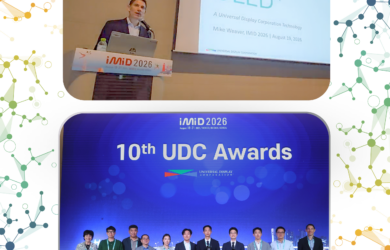
As a long-standing Gold sponsor of the International Conference on Display Technology (ICDT) 2026, Universal Display Corporation (UDC) was proud to support the conference’s 10th anniversary and contribute to the global dialogue on the future of display technology. During the event, UDC Principal Technologist Dr. Zhaoqun Zhou delivered an invited technical presentation on how OLED progress will increasingly be unlocked through system-level design, where materials, device architectures, pixel layouts, and display systems are optimized together, with efficiency as a core foundation.
Expanding OLED Device Architectures
As displays take on a larger role in enabling on‑device AI, richer visual experiences, and new form factors, performance demands continue to rise. Higher brightness, wider color gamut coverage (including BT.2020), and longer lifetime are now expected as baseline features, all while maintaining strict power efficiency targets. At the same time, the industry is adopting an expanding set of specifications from voltage levels to thermal stability, color performance based on the human eye’s perception in different lighting conditions (photopic metrics), color shift based on viewing angle, and more.
In his presentation, Dr. Zhou highlighted that meeting these demands in parallel is reshaping how OLED performance is defined and achieved, driving a systems‑level approach beyond the single‑stack OLED architectures that have dominated the industry. Emerging approaches, including tandem OLEDs and phosphorescent-sensitized fluorescence (PSF) pioneered by UDC and its partners, are gaining momentum as pathways to higher overall performance. While these architectures differ in structure, they share a common priority: maximizing energy efficiency to enable system-level gains.
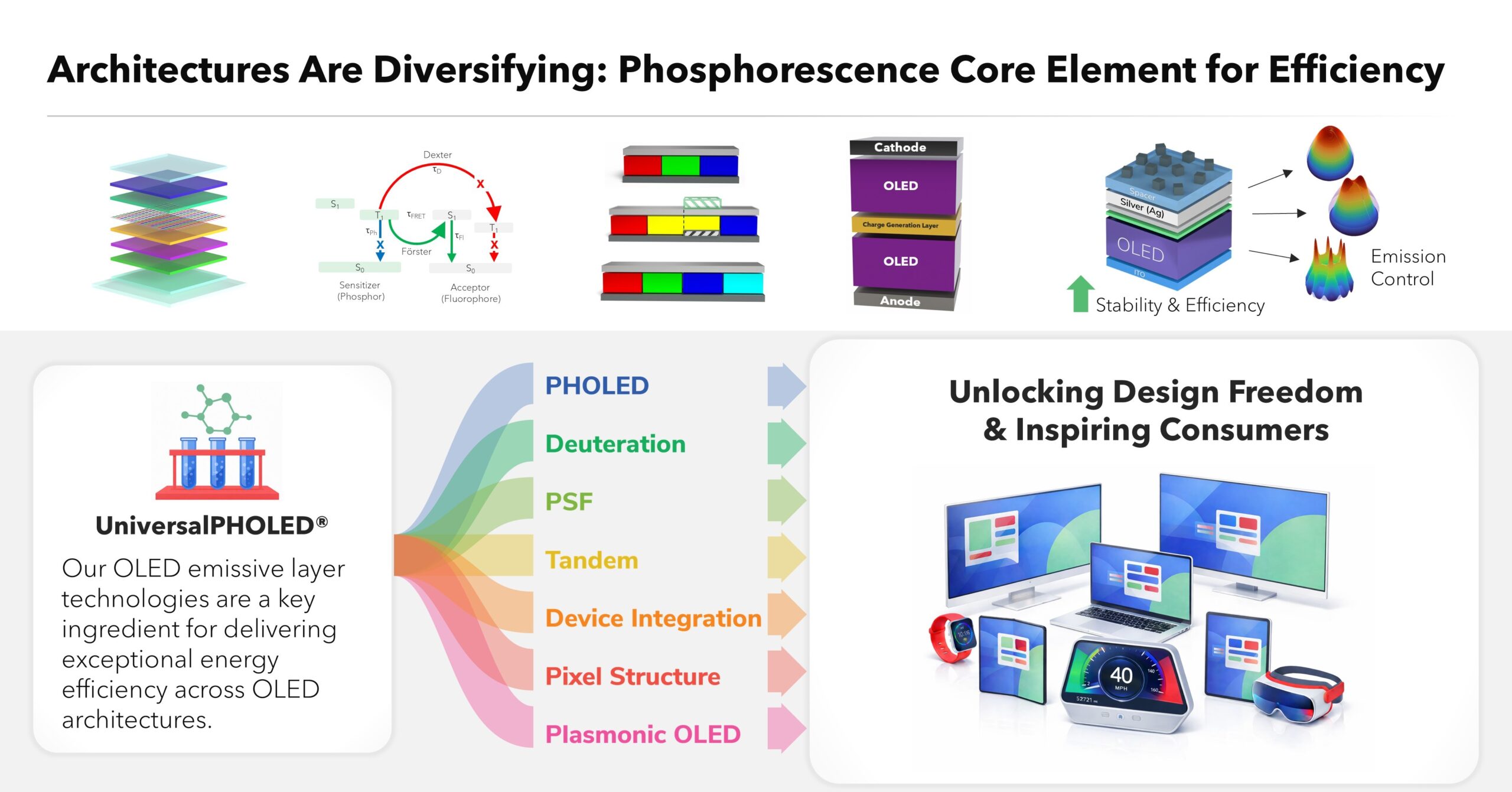
Caption: UDC’s OLED emissive layer technologies are key to energy efficiency across device architectures.
BT.2020: Power Challenges and Pixel Structure Solutions
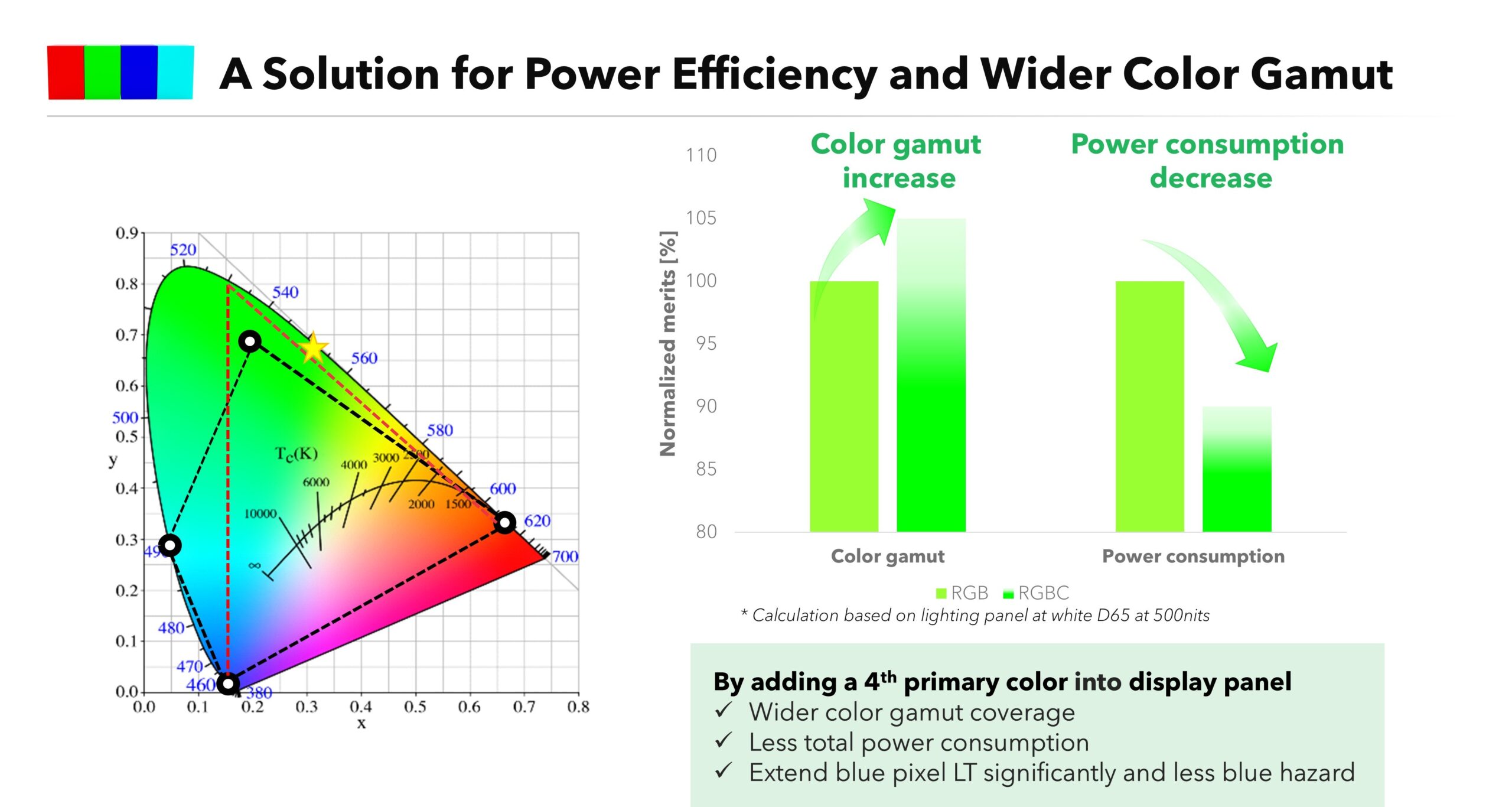
As the industry targets the expanded BT.2020 color space, power consumption becomes a major challenge. BT.2020 primary colors (red, green and blue) require higher brightness for HDR content, which can significantly increase power demand when traditional RGB pixel layouts are used.
Dr. Zhou outlined pixel architecture solutions, such as adding yellow or cyan subpixels (e.g., RYGB/RYYgB and RGBC layouts), that enable wide color gamut performance with substantially lower power consumption and improved lifetime. These approaches reposition BT.2020 not just as a color target, but as a system-level opportunity to redesign OLED panels for efficiency.
PSF: UDC’s Role and Key Results
A central highlight of the talk was UDC’s work in phosphorescent-sensitized fluorescence (PSF). In PSF OLEDs, a phosphorescent sensitizer harvests nearly 100% of excitons and transfers energy to a narrow emission profile fluorescent emitter. This combination delivers high efficiency with excellent color performance for the BT.2020 application.
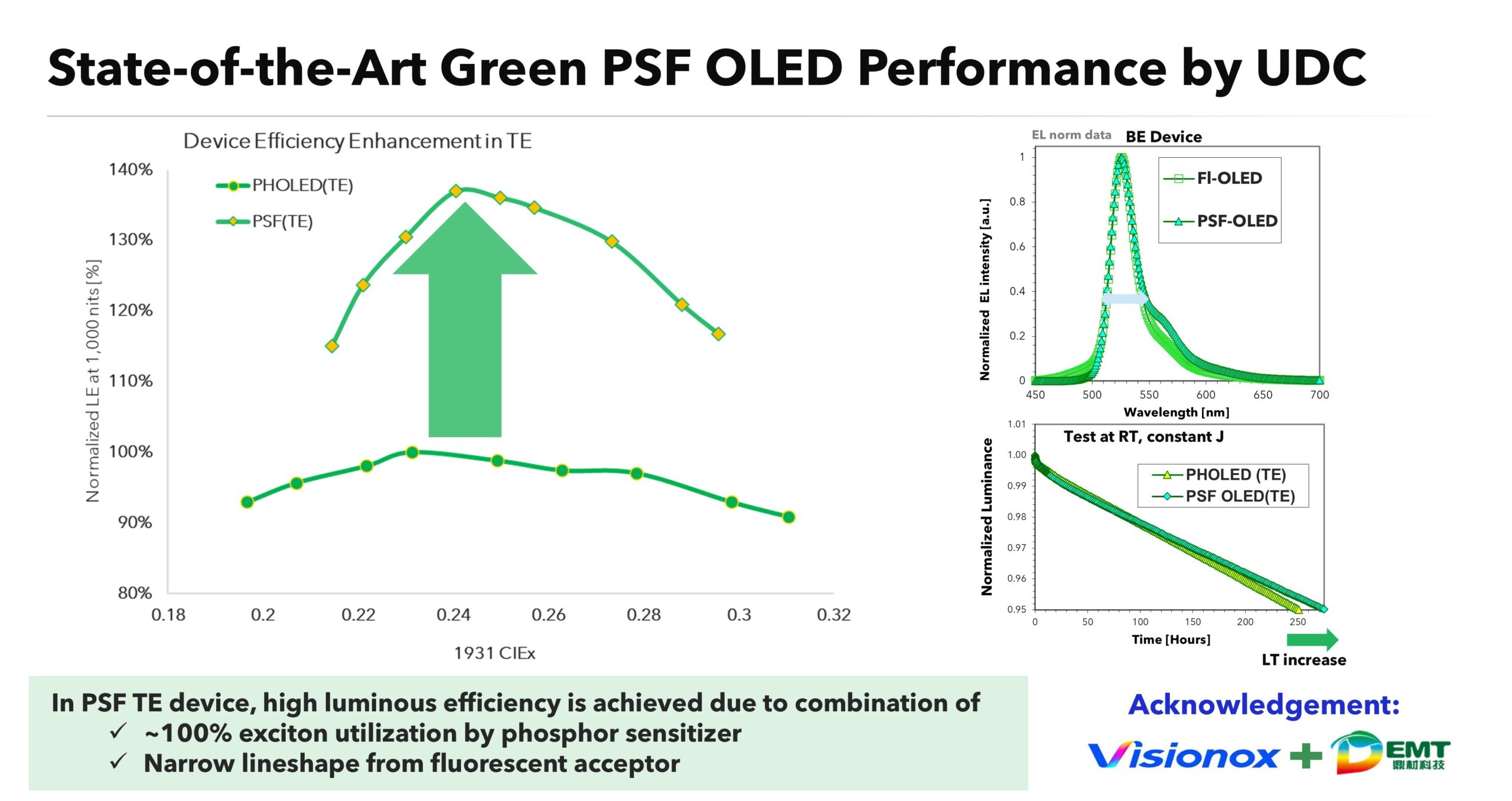
Caption: State-of-the-art green PSF OLED performance by UDC.
The presentation highlighted state-of-the-art green PSF results, including data generated in collaboration with Visionox, demonstrating reduced power consumption and extended lifetime relative to conventional OLED approaches. These results underscore how PSF can meaningfully contribute to next-generation AMOLED displays, and the vital role of UDC’s phosphorescence in enabling superior efficiency and performance in PSF systems.
Notably, the presentation also highlighted Visionox’s first commercial green PSF/pTSF product, reinforcing that PSF has moved beyond laboratory demonstrations into commercial products.
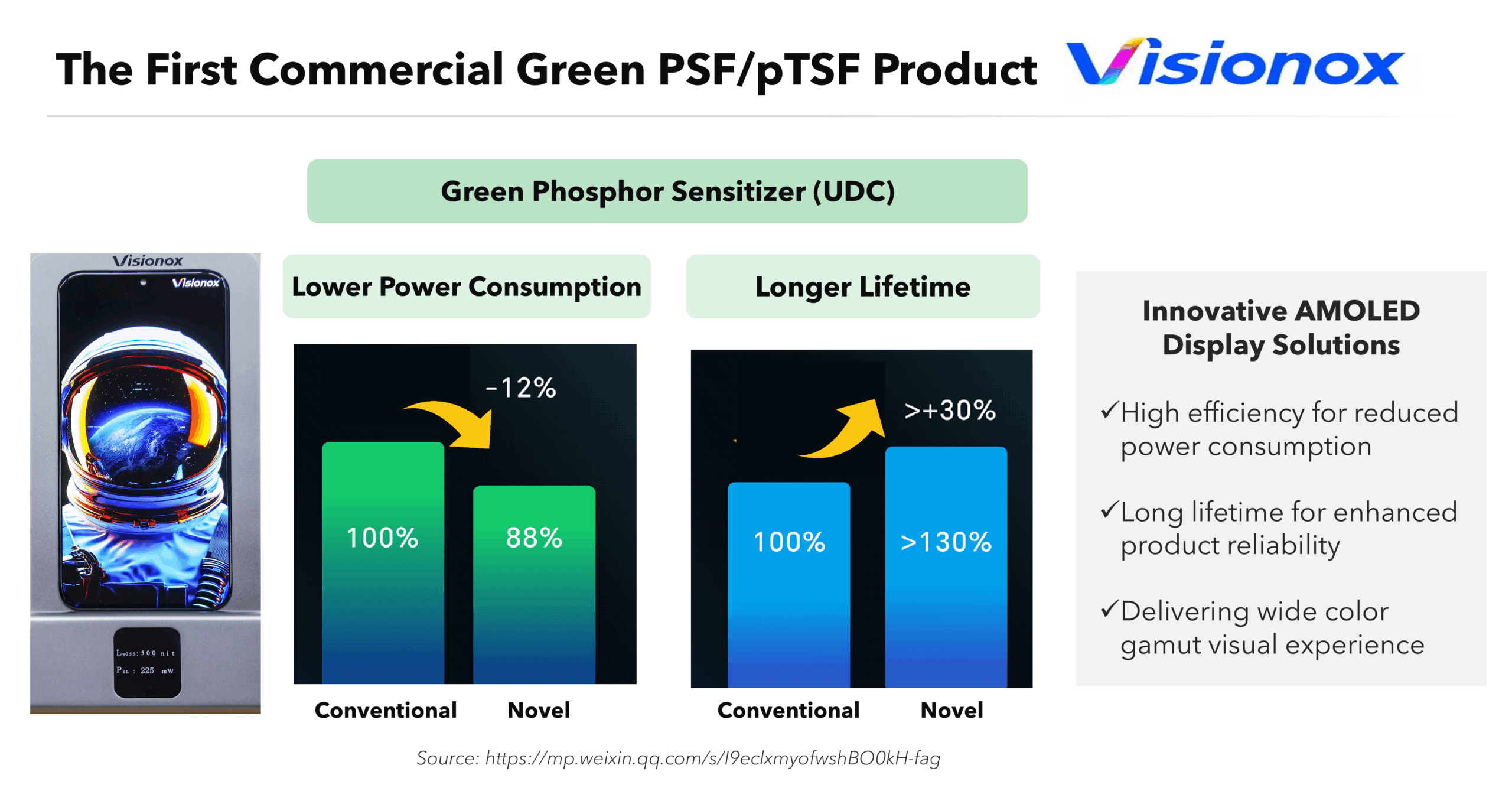
Caption:UDC and Visionox share PSF/pTSF results using UDC’s Phosphor sensitizer.
Plasmonic OLED: Enhancing Light Extraction
Dr. Zhou also discussed a UDC breakthrough device architecture in research and development, which has the potential to further advance efficiency, lifetime, and emission control. By coupling emissive layers with plasmonic structures, OLEDs can enhance light extraction while maintaining near Lambertian emission profiles—reducing angular color shift and improving viewing angles.
Such optical innovations become increasingly important as OLED architectures diversify and performance expectations continue to rise.
Phosphorescence: The Foundation Across OLED Architectures
Across all architectures discussed—PHOLED, PSF, tandem OLEDs, advanced pixel layouts, and plasmonic devices—phosphorescence remains a foundational efficiency engine. By enabling near‑100% internal quantum efficiency, phosphorescent materials support the performance needed for next‑generation OLED systems.
Improvements in OLED efficiency translate directly into system‑level benefits, including reduced power consumption, longer battery life, and improved lifetime at high brightness—benefits that become increasingly critical as display sizes grow and devices move toward HDR and wide color gamut formats.
A critical element of advanced efficiency is the development of UDC’s forthcoming PHOLED blue. PHOLED blue is expected to initially enable up to an additional 25% increase in display efficiency, delivering reduced overall display power consumption, improving lifetime at high brightness, and expanding design flexibility across architectures.
UDC: Combining Materials Innovation and Device Optimization
UDC’s ability to enable this next wave of OLED innovation is grounded in a unique combination of long‑term materials leadership, deep device‑level expertise, and decades of commercial experience. For more than 30 years, UDC has advanced OLED emissive layer technologies, translating scientific breakthroughs into scalable, manufacturable solutions, through close collaboration with partners across the OLED ecosystem.
The company’s whole‑system perspective—spanning materials design, device physics, and architecture‑level optimization—enables UDC to support a wide range of OLED approaches rather than a single device concept. As OLED architectures continue to diversify and efficiency requirements increase, UDC’s materials, technologies and system‑level know‑how remain central to helping customers navigate the expanding design space and deliver high‑performance, energy‑efficient displays at scale.