AI-Accelerated OLED Innovation: Human Insight, Faster R&D
UDC’s powerful R&D engine combines deep scientific expertise with advanced AI-machine learning capabilities
As OLEDs expand across devices and applications, performance expectations continue to rise. Higher efficiency, longer lifetime, greater color precision, and increased design flexibility are all advancing at once—reshaping what OLED materials must deliver.
The next display inflection point is here, and Universal Display Corporation’s strength lies in meeting this moment.
A Research Engine Designed for Continuous Advantage
At Universal Display Corporation, innovation has never been defined by a single breakthrough or a moment in time. It emerges from a research engine built to evolve. One that continuously absorbs knowledge, adapts to new challenges, and transforms complexity into opportunity. This engine is grounded in hands-on discovery chemistry, deep device understanding, and an R&D culture shaped by decades of learning and progress. As the OLED industry accelerates into its next chapter, it is fueling more discovery, greater differentiation, and stronger momentum than at any point in our history.
Our approach to innovation is rooted in collaboration. Discovery chemistry, device modeling, and advanced characterization are not isolated disciplines. They operate in close partnership, guided by a deeply experienced R&D team and informed by decades of proprietary insight. This collaborative approach enables us to translate molecular concepts into device-level performance with speed and reliability, while supporting multiple customer roadmaps and evolving market demands in parallel.
From advancing next-generation red and green materials to accelerating progress in blue, our R&D platform is engineered for sustained leadership.
AI-Accelerated OLED Innovation: Powerful Tools Amplifying Human Insight
As challenges in OLED materials grow more complex, success depends not only on precision but also on scale. The number of candidate molecules capable of meeting future performance requirements is effectively limitless—on the order of 10¹⁰⁰ possibilities. With advanced computing, what was once a fundamental constraint on discovery is now being transformed.
Long before AI became a mainstream tool, UDC recognized the power of advanced computation to accelerate innovation. More than a decade ago, the company established an in‑house computational science team as a core part of its R&D engine. Since that early investment, UDC has steadily built and refined its AI and machine‑learning capabilities—integrating them with hands‑on experimentation to support today’s AI‑enabled discovery workflows.
Today, AI‑driven modeling has transformed both the scale and speed of discovery. We now explore billions of candidate molecules up to 10,000× faster than traditional computational methods. Simulations that once required days can now deliver insight in moments, enabling broader exploration and faster iteration. For example, predictions of excited‑state triplet energies now run in milliseconds instead of hours, while lineshape (color purity) predictions are completed in hours instead of weeks.
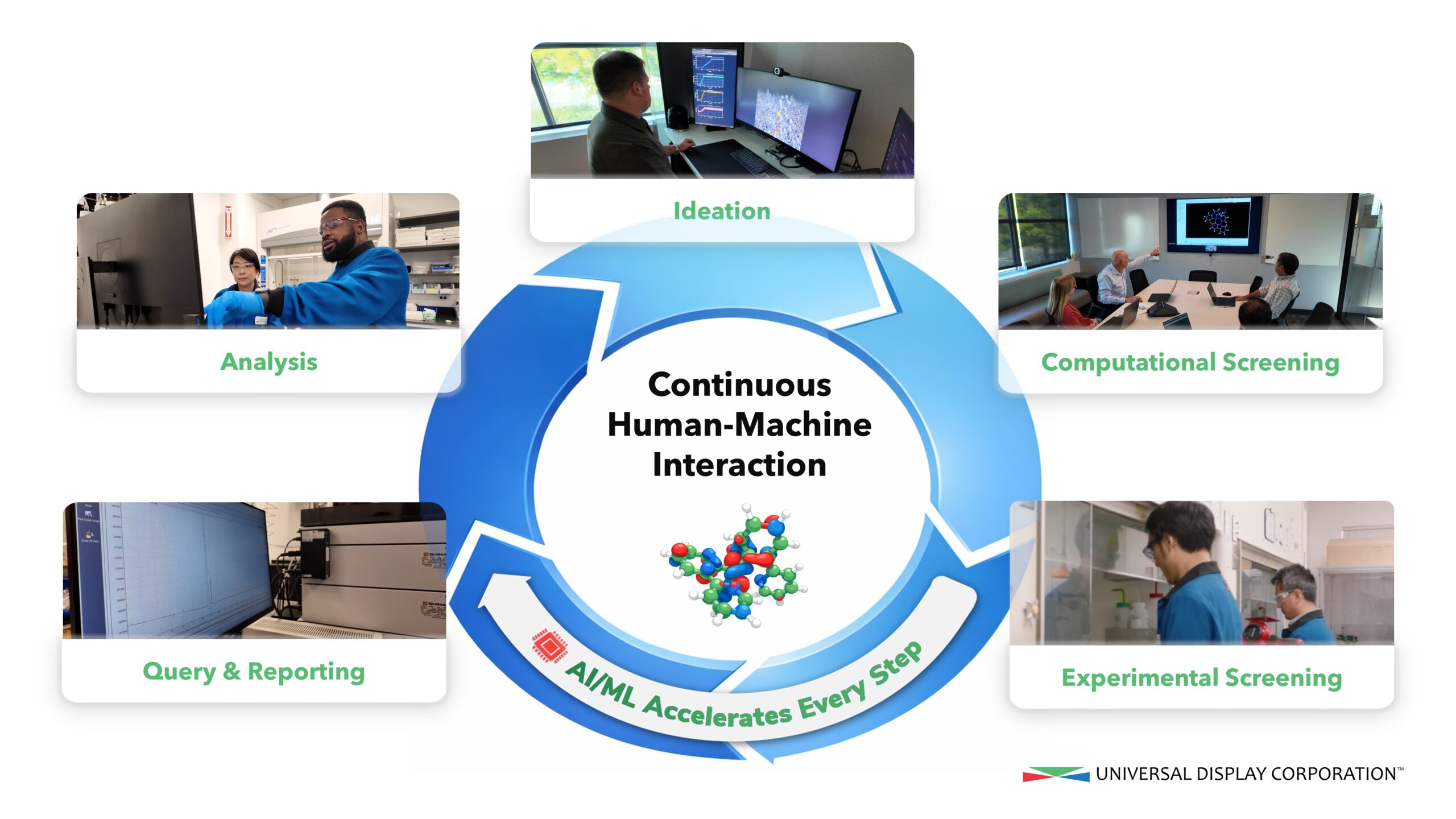
UDC integrates continuous human-machine interaction throughout its AI-accelerated OLED innovation workflows.
Beyond accelerating conventional approaches, AI is opening new frontiers. We are now predicting properties that were previously impractical or even impossible to model. This includes demanding properties like PLQY (brightness) and chemical stability (lifetime). Looking ahead, generative AI tools will continue to broaden the chemical design space we can explore, allowing us to cover more of the OLED landscape than ever before.
Used thoughtfully, these tools amplify experience rather than replace it. When advanced AI works hand‑in‑hand with our scientists—guided by proprietary data, deep device expertise, and more than 30 years of OLED know‑how—discovery becomes both faster and more intelligent.
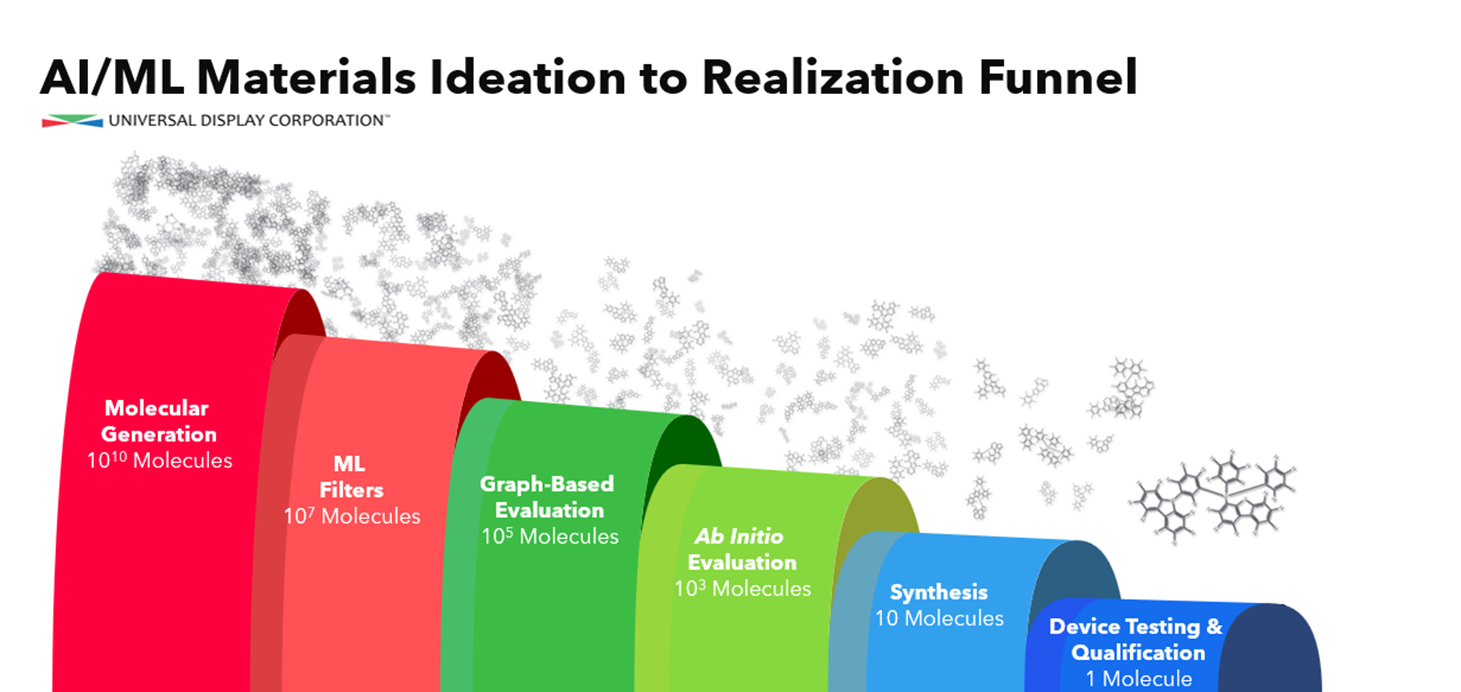
Great AI starts with great data. UDC has the world’s largest PHOLED database, built over decades of real‑world development and production. This data provides a powerful foundation for UDC’s AI-accelerated OLED innovation.
Unlocking New Momentum in Blue
The intersection of human expertise and AI acceleration is especially powerful in blue—one of the most technically demanding frontiers in OLED technology, with the potential to unlock new levels of energy efficiency and performance.
Blue materials must balance efficiency, lifetime, and color across a wide range of device architectures. Achieving that performance requires navigating complex tradeoffs at scale and applying a disciplined, data driven learning cycle across each generation of materials. Meeting all of these requirements demands entirely new molecules and chemical design spaces, which our AI-accelerated research engine is specifically built to expand and optimize with speed and precision.
High-throughput virtual screening and accelerated molecular simulations are opening new pathways. By rapidly identifying promising candidates and evaluating their properties early in development, we can move forward with greater confidence and speed. Each discovery informs the next, strengthening the broader R&D ecosystem and reinforcing progress across all emissive colors.
Leading Forward
Universal Display Corporation advances OLED materials and technologies through the way science, data, and imagination come together in practice. Our R&D platform unites deep scientific expertise, advanced modeling, and AI-accelerated OLED innovation to create enduring strength, supporting today’s opportunities while opening pathways to tomorrow.
With an innovation model built for an industry in motion, UDC continues to move OLED technology forward. By pairing scientific depth with intelligent acceleration, we are shaping progress across materials, architectures, and applications—and helping define what comes next.