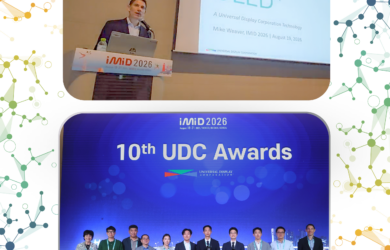
SID Display Week 2026: Expanding the Future of OLED Innovation
Advances in OLED architectures, energy efficiency, AI-driven devices, and high-efficiency blue signal the next phase of display innovation
At SID Display Week 2026, the world’s OLED ecosystem showcased its momentum as it prepares for its next phase of growth—driven by new architectures, increasing performance demands, and expanding applications.
From smartphones and IT displays to automotive and beyond, OLED innovation is accelerating. UDC’s deep expertise and expanding OLED solutions portfolio equip the industry with cutting-edge material systems, technologies, and device architectures—supporting leading panel makers as they create displays that enable not only exceptional visual experiences, but also more powerful, connected products.
Key Trends Shaping OLED’s Next Chapter
Across the conference, several themes defined where OLED is headed:
- Architectural evolution: Moving beyond the dominant single-stack OLED designs to expanded use of tandem structures and emerging approaches such as phosphorescence-sensitized fluorescence (PSF), which was pioneered by UDC and its partners.
- Energy efficiency as a system driver: Increasing demand for more energy efficient displays to power the next wave of OLED proliferation.
- AI-enabled devices: Driving new performance requirements, particularly around power consumption and responsiveness.
- Durability and design innovation: Supporting foldable, thin, and near-zero-bezel displays, while accounting for the human experience through new features such as switchable privacy modes and increased resilience for continuous use.
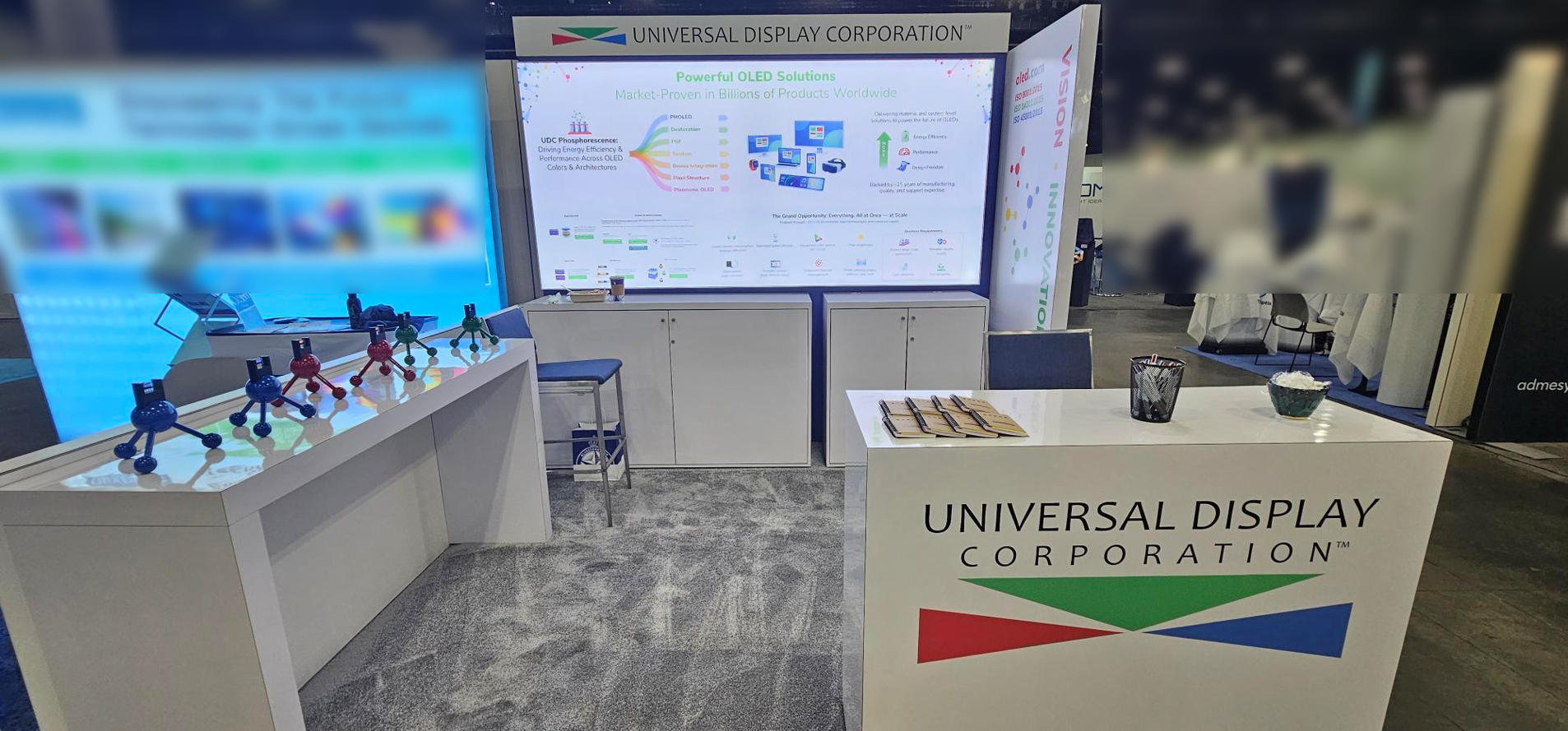
UDC’s booth at SID Display Week 2026, showcasing OLED innovation across emerging approaches along with its proven materials supply
UDC’s Focus: OLED Emissive Layer Innovation
At Display Week, Universal Display Corporation (UDC) highlighted its custom OLED solutions to support its customers in meeting this moment. These solutions include leading OLED emissive layer technologies, proven materials supply, advanced device architectures, and beyond.
The UDC booth discussed how, across emerging architectures and approaches, UDC’s phosphorescent OLED (PHOLED) technologies continue to serve as a core efficiency engine across both current and emerging OLED architectures.
UDC’s innovations are helping to:
- Improve power efficiency, enabling longer battery life and lower energy consumption
- Enhance brightness and performance, particularly for high dynamic range (HDR) and wide color gamut displays
- Extend device lifetime, supporting further OLED proliferation
- Support new architectures, including tandem and hybrid approaches combining phosphorescent with fluorescent materials
Efficiency gains increasingly translate into meaningful system-level benefits, and become even more important as the industry targets more ambitious standards such as BT.2020 color space and higher brightness levels,
UDC’s booth also highlighted the Company’s robust material supply capabilities, market-proven in billions of devices around the world. Not only are UDC’s OLED solutions designed to enable new levels of performance and efficiency, but they are also delivered at scale for use in devices we use every day. This underscores a key element in building the OLEDs of today and tomorrow—beyond breakthroughs, it is manufacturing and quality supply that will define technological success.
Advancing High-Efficiency Blue OLED
One of the most closely watched areas of OLED innovation is UDC’s groundbreaking work on high-efficiency blue, which is expected to enable new levels of display efficiency.
At SID, Dr. Fadi Jradi, UDC Senior Research Scientist, shared progress on the Company’s blue PHOLED development, including advances in lifetime, color, and efficiency. Currently, OLED devices use red and green phosphorescent OLEDs for energy efficiency, with blue still using more traditional fluorescent OLED.
As demand grows for brighter, thinner, and more power-efficient devices—especially with AI increasingly running on-device—high-efficiency blue represents a critical opportunity for the next generation of OLED displays. Stay tuned for a future blog post on this presentation and UDC’s advancements to bring the world high-efficiency blue.
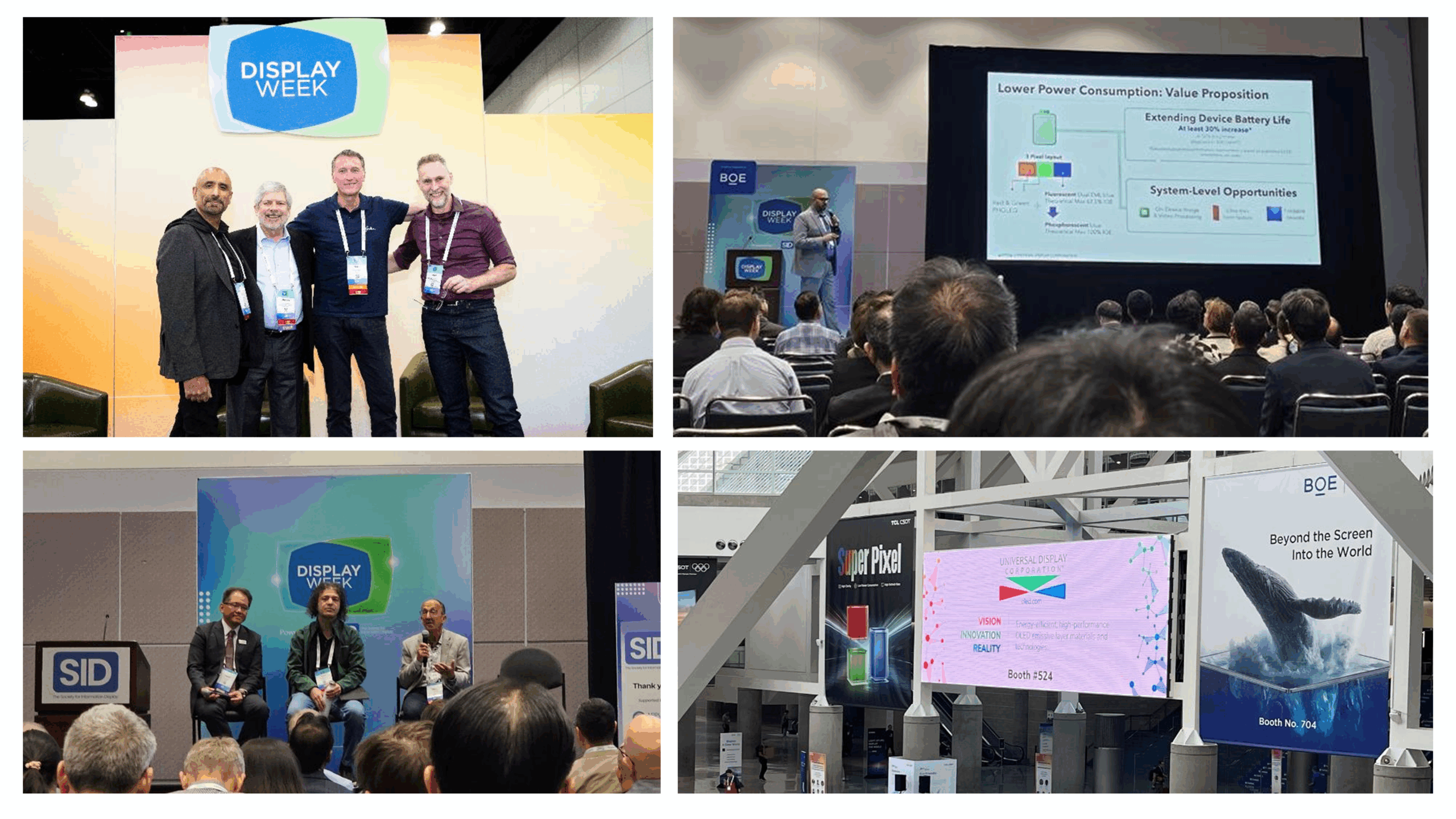
UDC shares insights in panel discussions, talks and a booth at SID Display Week 2026.
Industry Perspectives: Driving Demand and Growth
From teaching a short course to presenting and chairing symposium sessions, UDC and its sponsored research teams were deeply involved across the conference. UDC leadership also contributed to key industry discussions during the event.
At the CEO Forum, UDC President and CEO Steve Abramson emphasized the continued expansion of OLED across applications, with significant industry investment underway in IT and automotive display capacity. The broader takeaway: OLED adoption has substantial runway ahead as new technologies and use cases emerge.
“The OLED industry has grown over the last two decades from basically zero to $50 billion. There is no end in sight,” said Abramson during the panel discussion. “In order to get new power efficiencies and new lifetimes, new device architectures and new materials are being invented. This gives us a tremendous opportunity to grow the industry.”
In the SID Business Conference, UDC’s VP of Business Development, Dr. Mike Hack, highlighted how advances in display performance—particularly in power efficiency—are central to driving future smartphone demand. As devices evolve, AI capability, new form factors like foldables, and improved display quality are converging to shape consumer expectations.
Looking Ahead: Enabling the Next Phase of OLED Growth
SID Display Week 2026 underscored a pivotal moment for the OLED industry. As performance requirements expand and new applications take hold, the role of UDC’s materials and systems innovation becomes even more critical.
UDC continues to push the boundaries of OLED performance, supporting its customers with solutions that:
- Deliver efficiency at scale
- Support evolving device architectures
- Create value across the OLED ecosystem
With continued collaboration across the industry—and ongoing advances in materials, devices, and systems—the future of OLED remains both bright and expansive.